
Advertising · OpenAI
ChatGPT Ads: What They Are, Who Sees Them, and Whether Your Brand Should Care
Quick answer
ChatGPT ads are sponsored placements shown right inside the chat screen, to users on the free tier. Agencies running early tests are seeing stronger conversion rates than other social channels, but are split on whether to treat it as a search-like, bottom-funnel tactic or an awareness play, and most are starting with just 2-5% of search budget rather than a major reallocation. If you have consumer products and physical products, products with complex, research-heavy decision-making, or brands already seeing organic referral traffic from ChatGPT looking to amplify that voice, then you should explore more.
What are ChatGPT ads and how do they work?
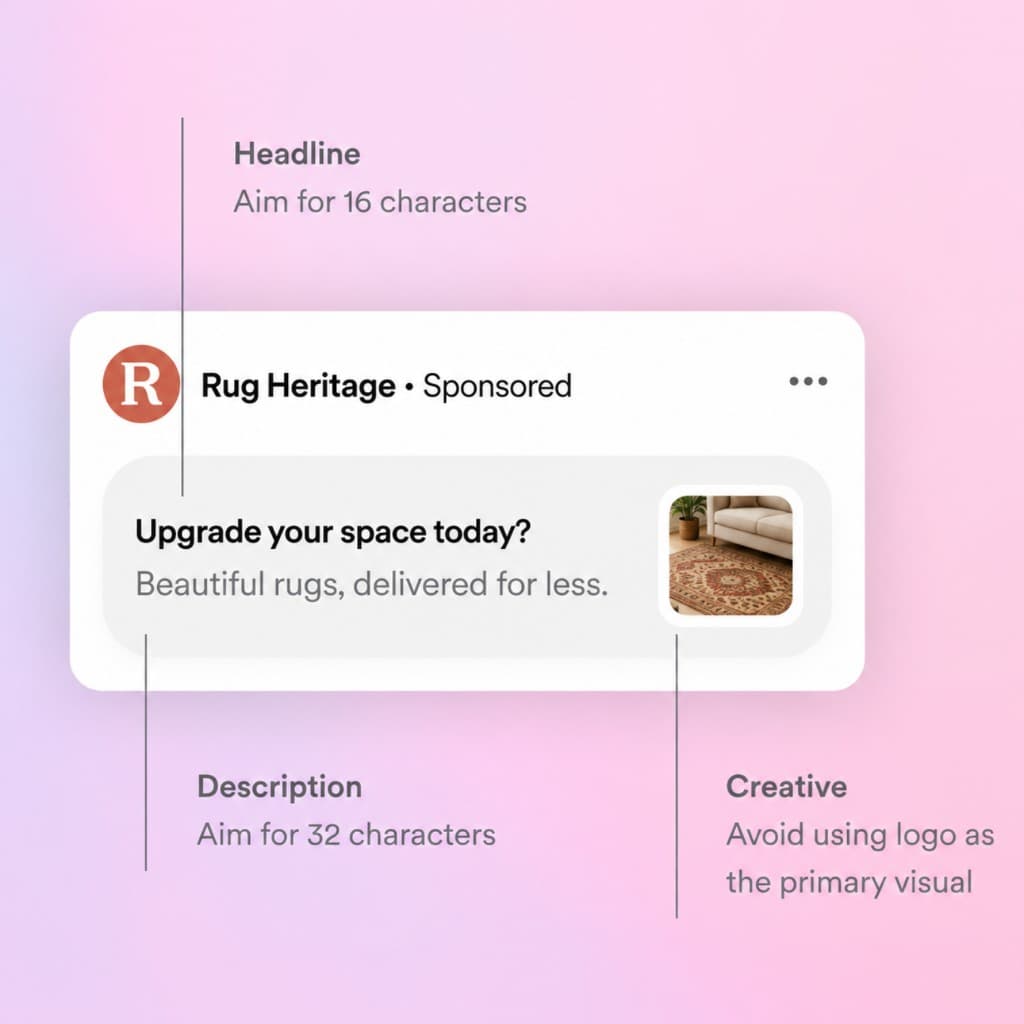
ChatGPT ads are sponsored placements that appear directly inside the chat, below a ChatGPT response. Each ad unit includes:
- Advertiser name
- Favicon (advertiser logo)
- Title (headline)
- Copy (description)
- Landing page link
- Image asset (creative)
Who may see ads
ChatGPT shows ads only to people on its free tiers. Plus, Pro, and Business plan users never see ads, and neither do accounts identified as belonging to users under 18, based on account-level age information and age prediction where available.
Selection and delivery
ChatGPT selects and delivers ads based on expected relevance and outcomes, weighing several signals: the context and intent of the current conversation, the ad's landing page, title, and copy, advertiser-provided context hints, and, when ad personalization is enabled, select signals from a user's broader ChatGPT experience. At the ad group level, advertisers can supply context hints describing the conversations, topics, or keywords where their product may be relevant. These guide matching, but aren't exact-match keywords and don't guarantee delivery in any specific conversation.
Should my brand advertise on ChatGPT?
A short framework rather than a yes/no:
Good fit right now
- Consumer products and physical products
- Products with complex, research-heavy decision-making
- Brands already seeing organic referral traffic from ChatGPT, looking to amplify that voice
- Companies wanting early-mover presence in a still-uncrowded ad environment
Weaker fit right now
- Brands whose core audience skews older: early signal from agencies running these ads suggests younger users are overrepresented on free tiers, though OpenAI hasn't published official age-tier demographics, so treat this as directional, not confirmed
- Brands prioritizing broad reach over precision (paid-tier users are excluded entirely, capping total addressable audience)
- Brands expecting to prove incremental ROAS immediately: early results are promising in places, but the sample size across the industry is still too small to say definitively how much of this is incremental vs. captured from other channels
- Teams unwilling to test with new or reallocated budget rather than pulling directly from proven search budget
Worth testing small, not betting big. This is true of any new, fast-changing ad platform, and pricing and formats have already shifted multiple times since February.
Early reactions from people actually using ChatGPT ads
Based on responses from 5 marketing agencies and brand teams using Harmony, collected August 2026. Each respondent answered two questions: their early results/reaction, and how they plan to use ChatGPT ads in the broader media mix. Answers are unedited.
Early results and first impressions
I was generating about $7,000 in monthly revenue through organic ChatGPT referrals, so I gave ChatGPT Ads a try. Two weeks in, I'm at a 2.5 ROAS.
One early result from a two-week test, not representative of typical performance yet, but a useful data point to watch.
We're only suggesting ChatGPT ads to clients running awareness campaigns. Search intent feels more decision-oriented, but we're not sure how much incremental revenue it can generate, so we're taking it slow without setting expectations.
So far, conversion rates are much higher than any of the other social channels we run ads on, once people click through and land on the website from ChatGPT. Seems like a strong option for a lower-funnel tactic.
How agencies plan to use it in the media mix
We see ChatGPT ads as a low-funnel tactic, similar to Google Search. It reaches people who already have intent to buy.
We're recommending ChatGPT ads mainly to consumer brands, since ads are only served to people not on paid plans, which inherently biases toward an audience that's less likely to spend on a digital purchase in general.
As an agency, we're looking at ChatGPT ads for both the consideration and purchase layers. If ChatGPT recommends something, users seem more likely to consider it than the same ad shown on a social platform, and if the product is strong enough, likelihood of purchase is higher too, compared to the social ads we run.
We're splitting our search budget into two parts now, allocating roughly 2-5% to ChatGPT ads, alongside Google and Bing Search. We're treating it as part of our search budget and tactic, not a separate line item.
Frequently asked questions
Are agencies actually seeing results from ChatGPT ads?
Early and mixed, but leaning positive on conversion quality. One agency reported conversion rates well above their other social channels once users click through from ChatGPT, and an early ecommerce test posted a 2.5 ROAS in its first two weeks. That said, several agencies are deliberately withholding firm expectations until there's more data on how much of this is incremental versus pulled from other channels.
Should I treat ChatGPT ads as top-funnel or bottom-funnel?
Agencies are split, but leaning bottom-funnel. Most respondents compared it to Google Search rather than social, describing it as reaching people who already have intent to buy. One agency is currently limiting it to awareness campaigns only, while others are actively using it at the consideration and purchase stages.
How much budget are other advertisers actually putting behind this?
Modest and treated as an extension of search, not a new line item. One agency described allocating roughly 2-5% of search budget to ChatGPT ads, alongside Google and Bing.
Is ChatGPT ads worth testing for my brand specifically?
Depends on your audience. Since ads only reach people on free tiers, agencies note this skews toward users who are inherently less likely to spend on a digital purchase in general, making it a better early fit for consumer brands than for brands selling to professionals who tend to be on paid plans.
Do all ChatGPT users see ads?
No, only Free and Go tier users. Plus, Pro, and Business plan users do not see ads, and accounts identified as belonging to users under 18 are excluded.
Is there a minimum ad spend?
No, self-serve campaigns can run without a minimum spend commitment.